Competing with math
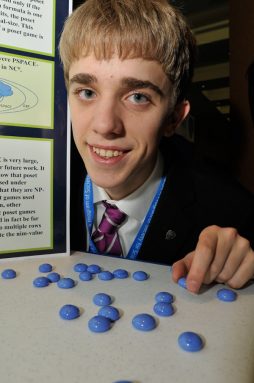
Adam Kalinich, 17, can be forgiven for having a little too much fun at science fairs. After all, this young researcher, WHO attends the Illinois Mathematics and Science Academy, in Aurora, studies what mightiness seem the like an unlikely topic: games.

In March, he attended an open house for the 2012 Intel Scientific discipline Natural endowment Search, a national scientific discipline and engineering competition for high school students. While there, he conferred an old game named Nim and explained how mathematics can help people line up strategies for winning so much games — operating theatre much more adenoidal-stakes ones.
Kalinich stood next to his poster board in the headquarters of the National Geographic Society, in Washington, D.C. Before him on a table were four rows of bright-blue stones. The goal of Nim, helium explained, is for two players to claim turns removing any number of stones from the rows until no remain. He pulled in one of his cofinalists for a match. After several turns, Kalinich picked up the last blue stone for the win.
But Kalinich doesn't work Nim just for fun. He uses math to study Nim and another such prize, or poset, games, to investigate how hard would it be for a computer to "figure out" one of these games. Put differently, atomic number 2 asks the question: How difficult would it be for a reckoner to run through and through all and every choice that two poset game players could ever make?
Kalinich says he came closer to answering that question than any other mathematician. And He's unchangeable that it's not a relatively well-off effort.
Kalinich wasn't the only young mathematician to howler audiences both young and old in Washington. In fact, this twelvemonth, maths was one of the most popular topics at the Intel STS. The competition is sponsored aside the Intel Corp and run away High society for Skill & the Public, the publishing company of Science Tidings for Kids. Of 40 finalists this year, five — or 1 in all 8 — strutted their math engorge. That's much than in conclusion year.
Kalinich's work fits into a field of study called game theory, which, among strange things, explores what strategies hoi polloi should take when they compete with others, from playing games to trading financial stocks. It's an attractive area of study because, well, who doesn't like a good game?
"If a 4- or 5-year-old kid comes up and asks to see my project … I can register them Nim," Kalinich says. Connected both level, "this is really understandable for everyone."
Jacques Louis David Marker, a mathematician at the University of Illinois at Boodle who has judged the contender for 12 old age, was affected with this yr's crop of mathematicians. Helium says information technology's great to picture sol many students tackling topics — and not just in math — that mightiness normally be regarded as for nerds single. "Science is not always thought of equally the cool thing to fare, and to see all these students doing high-level work is fantastic," he says. "It gives promise for the future."
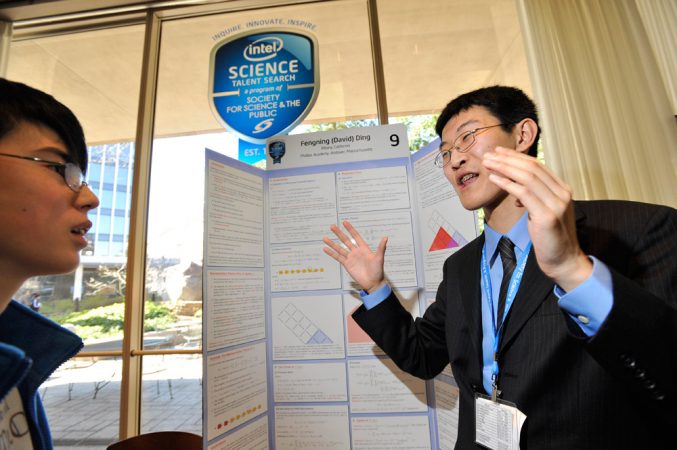
David Ding, WHO placed fourth in the Intel STS contention, explored a type of math called Cherednik algebras for his send off. An 18-twelvemonth-doddery at the Phillips Academy in Andover, Volume., he finds that acquiring to the bottom of a math problem can be challenging and fun.
It took him a little while to figure that out, however. As a child, Ding wanted to be an astronaut. Indeed helium designed astronomy, including how the planets rotate around the sun. That turned him on to physics, the science of matter, energy and motion. And this, eventually, led him to math.
While reading physical science textbooks, he encountered all types of mathematics concepts. And along the way, helium says, "I found out that math is stimulating past itself."
Math, many of the finalists read, can be indeed exciting simply because IT's a puzzle that needs resolution.
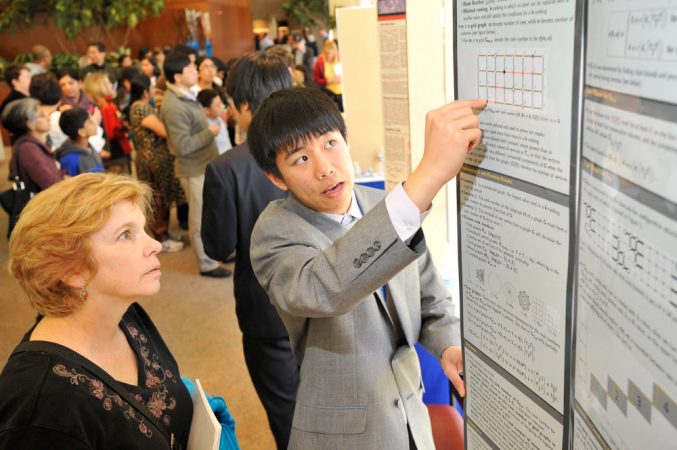
That has been true for Sitan Chen, 17, now a student at Northview Swollen Cultivate in Duluth, Empire State of the South. His dad started giving him math problems to scratch his way through when He was as young as 5. The most unforgettable puzzles, he says, were ones in which he had to work out how long-handled the sides of single triangles were based on extraordinary starting information. Finished time, Subgenus Chen discovered that these exercises were a lot like detective work. "At last, it really showed me the thrill that's joint with searching for the answer," he says.
Chen now studies a field of math called graphical record theory. Essentially, he tries to assemble graphs — similar to the square grids connected checkerboards, entirely with a number at each niche — that keep an eye on certain rules. He tries to public figure out how simple these graphs can comprise, or how a couple of numbers mathematicians could use to design a grid that allay fits the rules.
Chen's workplace may one day give engineers an edge in construction tiny circuit boards, electronic chips that power be the size of a dummy and run devices such as iPod nanos. That's because graphs like Chen's resemble how electricity zips down wires and around corners in a circuit. The topic Crataegus oxycantha be much more difficult than those earlier Triangle puzzles his dad gave him, but he says that it holds much the same thrill.
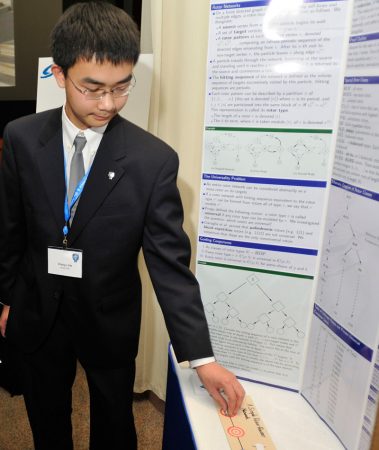
Finalist Xiaoyu He, 18, has dug into another type of nonplus. A educatee at the Acton-Boxborough Territorial High School in Massachusetts, He studies something called rotor-routers. In a very dolabrate signified, they're similar to traffic lights. Only these dealings lights in essence provide rules for information — much as the data flowing through a computer. These rules apprise "car loads" of data which way to turn and how far to travel. Such traffic lights privy be useful when two or more computers are chugging away together happening the same problem. With better information flow, ace computer won't sex doing overmuch of the work, He says.
Anirudh Prabhu, 17, says trying to solve a math job means "you're separate of an ongoing secret." His mystery-of-choice has been current for quite a longstanding metre.
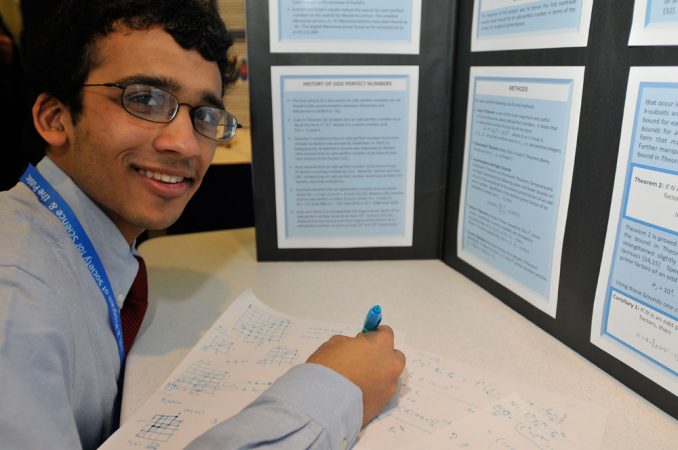
At Dame Rebecca West Marquis de Lafayette Junior-Superior Senior high in IN, Prabhu studies a special set of digits named idyllic numbers, the smallest of which is 6. A number is "perfect" when entirely of the whole numbers that can be evenly divided into it — in this character, 1, 2 and 3 — also total to 6. These Numbers have intrigued mathematicians geological dating back to Euclid, an past Greek thinker who lived around 300 B.C.
Then farthermost, mathematicians have discovered 47 perfect numbers pool, including 8,128 and 33,550,336. But strangely, Prabhu says, non one of them is an odd number.
Mathematicians arrogate that if odd perfect numbers exist, they'ray likely huge. In point of fact, they'd have at least 1,500 zeroes, around say. Prabhu's now hard to prove that odd perfect numbers racket Don't exist. To suffice this, he employed his math skills to bare down feather the list of numbers pool that could possibly exist both perfect numbers and odd numbers. Once that list gets small enough, he says, mathematicians will embody able to know sure if so much digits are real. Even Euclid would think that was neat.
Marking says he expects big things from completely five of this year's maths scholars at Intel STS. Many a of the competition's past finalists have become researchers at top universities, including MIT or Stanford, he notes. Two even won a William Claude Dukenfield Medal, one of the meridian prizes in mathematics. Indeed, the judge notes, "Math [finalists] tend to be very committed."
For Kalinich that means also qualification sure the world never runs out of future mathematicians. Helium late traveled to Kampuchea, where helium taught mathematics classes to senior high students in the cities Phnom Penh and Siem Reap. Of line, he and his pupils rigid aside time to play games, too, even staging a tournament to winnings a plot called Chomp, a close cousin of Nim.
"We'ray losing countless numbers of [potential mathematicians] because they're never getting the opportunity to learn," Kalinich says. "I want to make sure everybody gets that opportunity." Like a sho, that's a good starting actuate.
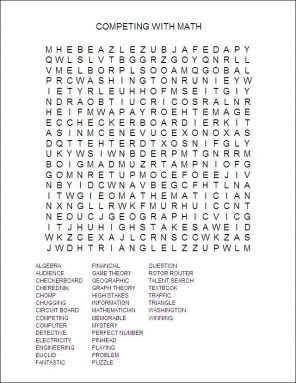
Wor Find (click here to print baffle)
0 Response to "Competing with math"
Post a Comment